Our beautiful garden was now full of holes. Mama had
dug up a few favorite plants to give to her friends. Other plants were given to
people like the woman who stopped by one day. She asked if she could have some
gladiolas. She said, “Since you’re leaving anyway…” She smiled an embarrassed smile.
Our
rented house was now an empty shell, with only three mattresses on the floor.
In the corner of Mama’s room was a large bag we called our Camp Bundle. We
tossed into it all the things we had been told to take with us. There were
sheets, blankets, pillows, dishes, and knives, forks, and spoons.
We
also put in other things we thought we’d need. These things were boots,
umbrellas, flashlights, tea cups, a hot plate, a kettle, and anything else we
thought we could use in camp.
Kay
said, “You know, we’re supposed to bring only what we can carry.”
We tried lifting two
suitcases. We found we could each carry two. But what were we going to do about
the Camp Bundle? Each day it grew and grew, like some living thing. We had no
idea how we would ever get it to camp. There was nothing to do but keep filling
it up and hope that somehow things would work out.
The night before we
left, our Swiss neighbors invited us to dinner. Mrs. Harpainter
made a wonderful chicken dinner. She served it on her best dishes. It made me
think of all the times we’d invited guests to our own house in happier days.
When
we got home, Marian and Solveig came from next door
to say good-bye. They brought gifts for each of us.
They
hugged us, saying, “Come back soon!”
“We
will,” we answered. But we had no idea when we would come back. Or even if we would ever come back.
The
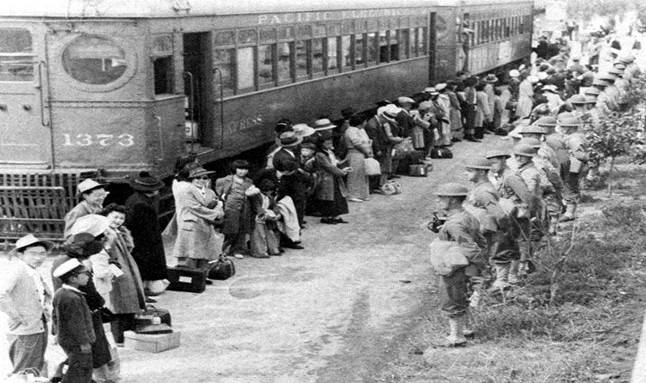
next morning, Mrs. Harpainter brought us breakfast on
a tray full of dishes with bright colors. Then she drove us to the First
Congregational Church of Berkley. The church was a Civil Control Station, where
we were supposed to report.
We
said our good-byes quickly. We couldn’t speak many words. Already the grounds of the church were filled with
hundreds of Japanese Americans. They held bundles with tags that showed their
names and their family’s number. At the curb were rows of trucks. They were
being loaded with large things that people could not carry by hand.
Kay
said in a low voice, “I wish they’d told us there would be trucks. We wouldn’t
have worried so much about our Camp Bundle.”
But
the army didn’t seem to care if we worried or not. To them, we were only
prisoners. There were guards all around the church. Their bayonets were ready. It wasn’t until I saw them that I really knew
what was happening to us. I was filled with horror. My knees felt weak, and I
almost lost my breakfast.
The
First Congregational Church had been good to us. Many of the families in the
church had offered to store things for the Japanese Americans while they were
gone. Now the church women were serving tea and sandwiches. But none of us
could eat.
Soon
we were loaded onto waiting buses. We began our one-way trip down streets we
knew well. We went across the Bay Bridge and down the Bayshore
Highway. Some people were crying quietly, but most of us were silent. We kept
our eyes on the window. We watched as sights we knew well slipped away behind
us, one by one.
Then
we were there-at the Tanforan Racetrack Assembly
Center. This was one of the 15 centers at racetracks and fairgrounds along the
West Coast where Japanese Americans were held.
From
the bus window, I could see a high fence with barbed wire that was around the
whole area. At each corner of the camp was a guard tower with soldiers.
The
gates swung open to let us in. The guards with their guns closed them behind
us. We were now locked in. The guards would be there 24 hours a day.
We
had never broken the law. We had now become prisoners of our own country.
There
was huge crowd of us. It looked as if there was a horse race that day, except
that all the people there were Japanese of all ages, sizes, and shapes.
We
looked through the crowd for faces we knew. It felt good to find several
friends. They had arrived a few days earlier from Oakland.
They
called to us: “Hey Kay and Yo! Over here!”
Our
friends led us through the crowds to a spot where doctors looked down our
throats and said we were healthy. Then they helped us find the place we were
supposed to be – Barracks 16, Apartment 40.
I
asked, “We get apartments?”
My
friend said, “Not the kind of apartment you’re thinking of, Yo. Wait, you’ll see.” My friend knew I’d be shocked.
Mama
was wearing her hat, gloves, and Sunday clothes. This was because she would
never have thought of leaving home any other way. In her good Sunday shoes, she
picked her way over the mud puddles that the rain had left the night before.
The army had quickly built dozens of barracks around the track for the eight
thousand of us. Each barrack was split into six rooms. Each family got one
room. But our barrack was not one of these.
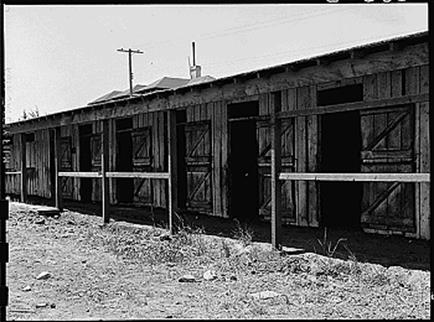
Our
barrack turned out to be nothing but an old horse stable. Our “apartment” was a
small, dark horse stall, 10 feet by 20 feet. I couldn’t believe what I saw.
Dirt,
dust, and bits of wood were all over the floor. I could smell that horses had
lived there. There were two tiny windows on each side of the door.
Tiny
bodies of spiders and bugs had been painted onto the walls by army painters. A
single light bulb hung from the ceiling. Three army cots lay on the dirty
floor. This was to be our “home” for the next five months.
One
of our friends found a broom and swept out our stall. Two of the boys went to
pick up our mattresses. They had to fill them with straw themselves.
Another
friend loaned us some dishes and silverware until our bundle was delivered. She
said, “We’d better leave soon for the mess hall before the lines for dinner get
too long.”
For
now, all meals were being served in the basement. Holding our plates and
silverware, we made our way down the muddy racetrack.
When
we got to the mess hall, there were already long lines of people waiting to get
in. Soon we were separated from our friends. Mama, Kay, and I took our places
at the end of one line. We stood close together to keep warm. A cold, sharp
wind had begun to blow as the sun went down. It blew dust in our faces.
I
felt like a refugee in a strange
land. Being here was not only degrading,
but it did not seem real. It was like an awful dream.
Since
we had missed lunch, I was eager for a nice hot meal. But dinner was a piece of
bread, a boiled potato, and two sausages from a can. The cooks picked up the
food with their fingers and dropped it on our plates.
We
ate at picnic tables in the cold, damp basement, along with hundreds of people.
Even though I was still hungry, I couldn’t wait to get back to our stall.
It
was dark now. The north wind was blowing into our stall from all cracks around
the windows and door. We put on our coats and sat on our mattresses, too sad to
even talk.
Then
we heard a truck outside. A voice called, “Hey, Uchida! Apartment 40!”
Kay
and I rushed to the door. “That’s us!” we called. We saw two boys trying to get
our big Camp Bundle off their truck.
The
boys were grinning. They asked us, “What ya’ll got in
here anyways? Did ya bring everything in your whole
darn house?”
I
was embarrassed. Our bundle was the biggest one on the truck.
I joked, “It’s just our pet rhino.”
While
the boys were still laughing, we dragged our huge bundle into the stall.
Quickly, we untied all the knots we’d tied just that morning.
Everything
we’d put in the bundle rolled out like old friends.
I
grabbed the kettle. “I’ll go get some water,” I said.
I went
quickly to the women’s toilets and washroom. It was about 50 yards from our
stable. While I was gone, Kay and Mama got our sheets and blankets from the
bundle to make up our cots.
When
I got back, I had news for them.
“There
are no doors for the toilets or showers,” I said in horror. “And we have to
wash up at long tin sinks. They look like they were used for feeding horses.”
I
had also taken a look at the laundry barrack. It had rows of tubs for washing.
Everything, even sheets and towels, had to be washed by hand. They were still
empty, but in the morning there would be long lines of people waiting to use
those tubs.
Mama
said, “Well, at least we can make some tea now.”
We
plugged in the hot plate and waited for the water to boil.
Then
came a knock at the door. This was the first of many
knocks we would hear, as friends found out where we lived.
A
voice said, “Hey Kay and Yo. Are you home?”
Four
of my college friends had come by to see how we were doing. They had brought
along the only snack they could find. It was a box of dried prunes. The day
before, I wouldn’t have eaten the prunes. But now they were as welcome as a box
of the special chocolates Papa used to bring home from San Francisco.
We
sat close to the warmth of the hot plate. We sipped the tea Mama had made for
us. We wondered how we had come to be in this awful place.
We
were angry that our country had taken away our civil rights. But we had been
raised up to respect and trust the people in power. We never thought to
protest, the way people would today. The world was a totally different place
then.
Back
then, there had been no freedom marches. No one had heard yet of Martin Luther
King, Jr. No one knew about pride for one’s own people. Most Americans didn’t
think much of civil rights. They would have given us no support if we had tried
to stop the army from taking us away.
We
thought that by going along with our government, we were helping our country.
We did not know then how badly our leaders betrayed us.
They
had put us in prison. They knew it was against the Constitution. And they knew
there was no need to put us in prison. We were no danger to anyone.
We
wondered how America – our own country – could have done this to us? We tried to cheer up. We talked about steaks and hamburgers
and hot dogs as we ate the cold dried prunes.