SAFER STREETS
Mr. Steven Mann
PS 171: Grade 4
INTRODUCTION:
Walking and biking through New York City should be a safe way to get around, but our busy streets aren't always safe for pedestrians and cyclists. Vision Zero, implemented in 2014, has tried to solve this problem – one that goes back all the way to 1899, when the first pedestrian ever struck by a car in the United States was a New Yorker. Today, thousands of New Yorkers are hurt in street crashes every year, including kids walking and biking to school.
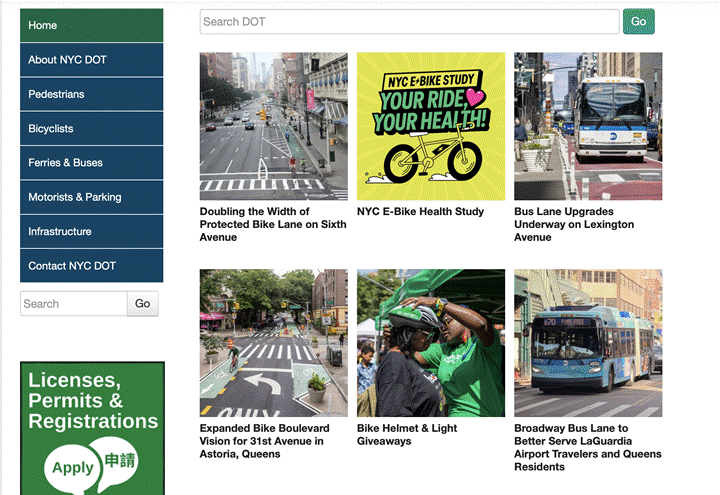
The New York City Department of
Transportation (NYC DOT) has hired your team of safety consultants from the
National Highway Traffic Safety Administration (NHTSA) to help understand the
problem of NYC streets being dangerous for pedestrians and cyclists, and to
design solutions that will make NYC streets safer for everyone by using the six
step Public Policy Analyst (PPA).


TASK:
WEEK 1: You will read an introductory article and take notes on a specific street safety issue to gain general familiarity with the dangers it creates for pedestrians and cyclists in a major city.
WEEK 2: You will conduct additional research using the six steps of the Public Policy Analyst (PPA) from a variety of media sources by accessing the street safety links doc and choosing information about your specific street safety issue.
WEEK 3: You will create a Google Slide presentation that explains the causes of your street safety issue, warns people about the dangers it creates, and informs them of safety precautions they can take when walking or biking.
WEEK 4: You will design a workable solution to help protect pedestrians and cyclists and save lives by creating a poster that explains your solution.
PROCESS:
You will choose a street safety issue you would like to research and be assigned into a group based on your interest. You will use the Public Policy Analyst (PPA) to conduct research on your own, then meet together as a group to collate research and create the presentation and solution.
1. DEFINE THE PROBLEM
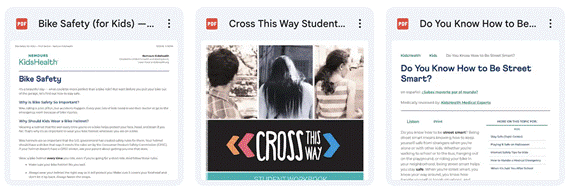
You will build background knowledge on how street safety affects a major population center like NYC. You will do this by choosing 1 or 2 articles or websites that interest you most while taking notes about the article or website.
Define the Problem: Worksheet#1
2. GATHER THE EVIDENCE
You will research current issues of traffic safety in NYC and the harm that they cause. You will do this via a web search while taking notes.
Gather the Evidence: Worksheet #2
3. IDENTIFY THE CAUSES
Use the links below to research what causes street safety problems for pedestrians and cyclists in New York City. As a group, choose the causes that are most related to your assigned street safety issue and take notes using your research notes page.
A. Speeding Cars
Why driving too fast makes streets so dangerous, and how speed changes the chance that a person walking or biking will be hurt.
Source: NHTSA – Speeding
B. Distracted Driving
How drivers using phones, eating, or doing other things while driving creates serious danger for pedestrians and cyclists.
Source: NHTSA – Distracted Driving
C. Not Enough Safe Places to Bike
Why streets without protected bike lanes are dangerous for cyclists, and what makes a bike lane truly safe.
Source: NYC Vision Zero – Safe Cycling
D. Being Hard to See (Visibility)
How low light, dark clothing, and parked cars blocking the view make it harder for drivers to see pedestrians and cyclists.
Source: Safe Kids Worldwide – Pedestrian Safety
E. Dangerous Intersections
How most pedestrian crashes happen at intersections and crosswalks, and why drivers fail to yield to people on foot.
Source: NHTSA – Pedestrian Safety
F. Big Trucks and Blind Spots
Why large trucks and delivery vehicles are especially dangerous on city streets, including the blind spots where drivers can't see.
Source: NYC DOT – Trucks
Identify the Causes: Worksheet #3
4. EVALUATE AN EXISTING POLICY
NYC DOT and the Vision Zero program have many policies already in place to make streets safer. Use the links below to research what the city is already doing. As a group, decide which policies are working well, which could be improved, and which might apply to your street safety issue.
A. What Is Vision Zero?
An overview of NYC's plan to eliminate all traffic deaths. This page explains the goal and big-picture strategy.
Source: NYC Vision Zero – What It Is
B. Street Design and Engineering
How NYC is redesigning streets, intersections, and crosswalks to make them safer for everyone (the 'engineering' approach).
Source: NYC Vision Zero – Engineering
C. Speed Management
How NYC sets and enforces speed limits, including the 25 MPH default city speed limit and school zone slow zones.
Source: NYC Vision Zero – Speed Management
D. Speed and Red Light Cameras
How automated cameras catch speeders and red-light runners, especially in school zones.
Source: NYC Vision Zero – Automated Enforcement
E. Safety Education in Schools
Programs like 'Cross This Way' that teach kids how to be safe pedestrians, and other education programs across the city.
Source: NYC Vision Zero – Education
Evaluate an Existing Policy: Worksheet #4
5. DEVELOP SOLUTIONS
You will decide on possible solutions that could help NYC decrease street safety incidents.

6. SELECT THE BEST SOLUTION (Feasibility vs. Effectiveness)
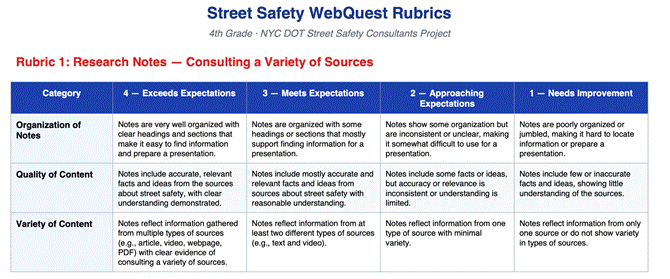
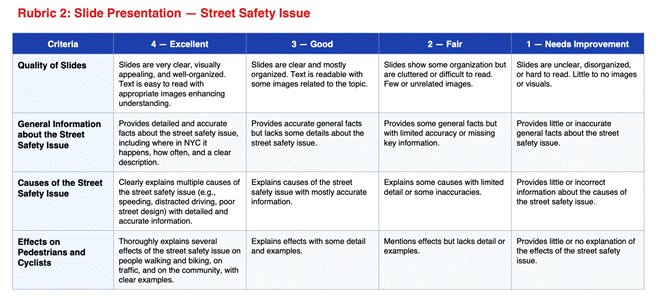
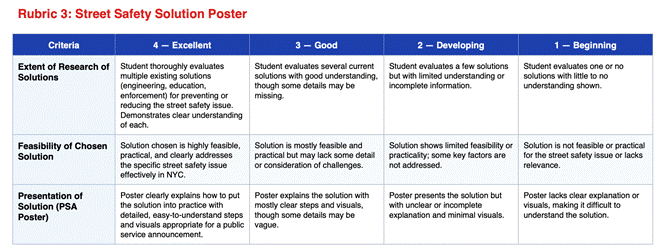
EVALUATION:
CONCLUSION:
As safety consultants from the National Highway Traffic Safety Administration (NHTSA) you have now learned the causes of street safety issues, the effects it can have on NYC, and solutions to minimize dangers on city streets.
You have used the six step Public Policy Analyst (PPA) to research, create an informative presentation, and solution.
You are now ready to present to the New York City Department of Transportation (NYC DOT)! Thank you for helping people learn possible solutions that can help NYC decrease street safety incidents.
STANDARDS:
English Language Arts (NY Next Generation ELA Standards: Grade 4)
● 4R7: Identify information presented visually, orally, or quantitatively (e.g., in charts, graphs, diagrams, timelines, animations, or interactive elements on web pages) and explain how the information contributes to an understanding of the text in which it appears. (Students interpret crash data, infographics, and street-design diagrams.)
● 4W6: Conduct research to answer questions, including self-generated questions, and to build knowledge through investigation of multiple aspects of a topic using multiple sources. (The full research arc across Weeks 1–2.)
● 4W2: Write informative/explanatory texts to examine a topic and convey ideas and information clearly. (The Google Slides presentation in Week 3 and the solution poster in Week 4.)
Social Studies (NY K-8 Social Studies Framework: Grade 4 Practices)
● Social Studies Practice A — Gathering, Using, and Interpreting Evidence: Develop questions about New York State and its communities; identify, select, and evaluate evidence about events from diverse sources. (Students research a real NYC public-safety problem using NYC DOT and Vision Zero sources.)
● Social Studies Practice F — Civic Participation: Identify ways in which they and their classmates can work together to make a difference in their community. (Students advise NYC DOT and produce a public service announcement-style poster proposing real changes.)
Math (NY Next Generation Math Standards: Grade 4)
● NY-4.MD.2: Use the four operations to solve word problems involving distances, intervals of time, liquid volumes, masses of objects, and money, including problems involving simple fractions or decimals, and problems that require expressing measurements given in a larger unit in terms of a smaller unit. (Students work with crash data, speed-versus-injury statistics, distances between protected crossings, and similar measurement problems while researching causes.)