8th Grade Biology WebQuest
Rosalily Belandres-Rios
INTRODUCTION
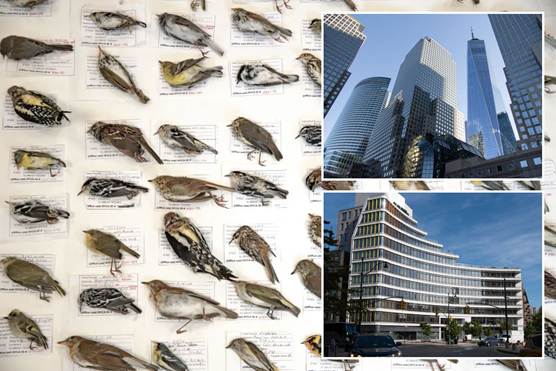
Every year, thousands of migratory birds die after flying into reflective glass windows in NYC skyscrapers and buildings. Birds often mistake reflections of the sky, clouds, or trees for real habitat. Artificial lights at night can also disorient migrating birds and attract them toward dangerous buildings. Scientists estimate that between 90,000 and 230,000 birds die each year in New York City from window collisions. NYC Bird Window Collisions.mp4 Flaco's Final Flight Discussion Activity.pdf
TASK
Imagine you are part of a team of wildlife conservation scientists working for the New York City Bird Alliance. Your team has been asked to investigate a growing environmental problem in New York City: birds colliding with glass buildings and windows.
Your mission is to investigate the causes of bird collisions, analyze scientific evidence, evaluate current NYC policies, and design realistic solutions that could help save migratory birds.
Using Public Policy Analyst (PPA), students will:
● Explain why bird-window collisions occur.
● Analyze evidence related to bird collisions in NYC.
● Identify human activities that contribute to the problem.
● Evaluate bird-friendly building policies.
● Design and defend solutions to reduce bird collisions.
● Create a slide presentation.
PROCESS
Time frame - 5 class periods Grouping - in groups of 4
STEP 1: Define the Problem
Research and define:
● bird-window collisions
● migratory birds
● reflective glass
● light pollution
Guiding Questions
1. Why do birds collide with windows?
2. Why is NYC especially dangerous for migratory birds?
3. How do artificial lights affect bird migration?
4. Why are migratory birds important to ecosystems?
STEP 2: Gather the Evidence
Gather and analyze evidence related to bird collisions in New York City.
Examine:
● bird collision statistics
● migration maps
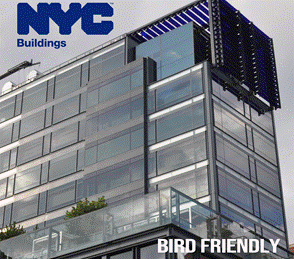
● photographs of reflective buildings
● bird collision hotspot maps
Guiding Questions
1. What trends do you notice in the data?
2. Why are glass buildings dangerous to birds?
3. How does light pollution affect migration?
4. Why are collision numbers likely underestimated?
Suggested Resources
● NYC Bird Alliance – Project Safe Flight
● Audubon – Bird-Friendly Buildings
● NYC Bird Alliance – Lights Out Initiative
STEP 3: Identify the Causes
Investigate the main causes of bird collisions.
Examples:
● reflective glass
● transparent windows
● artificial lighting
● skyscrapers
Guiding Questions
1. Why can birds not recognize glass as a barrier?
2. How do reflections confuse birds?
3. Why are nighttime lights dangerous during migration?
4. Which buildings are most dangerous to birds?
STEP 4: Evaluate Existing Policies
Research New York City’s bird-friendly building laws and conservation efforts.
Examples
● NYC bird-friendly building legislation
● Lights Out NYC
● Project Safe Flight
● bird-safe glass requirement
–Guiding Questions
1. What is the purpose of the law or program?
2. How effective has it been?
3. What are its strengths and weaknesses?
4. Should more buildings be required to follow these rules?
Suggested Resources
https://www.audubon.org/news/new-york-city-passes-landmark-bill-make-more-buildings-bird-friendly?
https://www.nyc.gov/assets/buildings/bldgs_bulletins/bird_friendly_guidance_document.pdf
https://www.nycbar.org/reports/support-for-the-federal-bird-safe-buildings-act-of-2025/
STEP 5: Develop Solutions
Work with your group to design solutions that reduce bird collisions.
Possible Solutions
● bird-safe glass/screen
● window decals/patterns
● reducing nighttime lighting
● automatic blinds
● green roof redesigns
● motion-sensitive lights
Requirements
Your solution must:
● reduce bird collisions
● be realistic
● explain environmental benefits
● identify possible limitations
STEP 6: Select the Best Solution
(Feasibility vs. Effectiveness)
Evaluate your group’s solutions using the chart below.
Evaluating Solutions Worksheet.docx
|
Solution |
Effectiveness |
Cost |
Feasibility |
Overall Rank |
|
|
|
|
|
|
|
|
|
|
|
|
|
|
|
|
|
|
|
|
|
|
Discussion Questions
1. Which solution would save the most birds?
2. Which solution is most affordable?
3. Which solution could NYC implement quickly?
4. What trade-offs exist?
STEP 7: Presentation
As environmental scientists, your group will present your findings and proposed solution to the class as if you were presenting to the New York City Environmental Protection Board. Each group will be given 5–7 minutes. Every group member must participate. Presentation Rubric.docx
Students may choose ONE of the following:
● Google Slides
● PowerPoint
● Canva presentation
Your group presentation must include:
- Title Slide
- The Problem
- The Causes of the Problem
- Evaluate Existing Policies
- Develop Solutions
- The Best Solution Proposed
- Conclusion, Reflection, Recommendation
After all groups have presented, the students will complete a reflection worksheet. Presentation Reflection Questions.docx
EVALUATION RUBRIC
|
Criteria |
4 – Exceeds Expectations |
3 – Meets Expectations |
2 – Approaching Expectations |
1 – Beginning |
|
Research & Accuracy |
Information is accurate, detailed, and demonstrates thorough understanding of the topic. |
Information is mostly accurate and shows clear understanding. |
Some information is inaccurate or lacks detail. |
Minimal understanding; many inaccuracies present. |
|
Evidence & Data Analysis |
Strong use of evidence, graphs, and data to support conclusions. |
Adequate use of evidence and data. |
Limited evidence or weak data analysis. |
Incomplete or missing evidence/data analysis. |
|
Policy Evaluation |
Provides detailed analysis of strengths, weaknesses, and effectiveness of the policy. |
Provides sufficient evaluation of the policy. |
Basic evaluation with limited detail. |
Incomplete or minimal evaluation. |
|
Solution Design |
Solution is creative, realistic, evidence-based, and well explained. |
Solution is realistic and adequately explained |
Solution lacks detail or realism. |
Solution is incomplete or unclear |
|
Participation & Collaboration |
Fully engaged and consistently contributed positively to the group. |
Mostly engaged and participated appropriately. |
Some participation but inconsistent engagement. |
Minimal participation or off-task behavior. |
CONCLUSION
Congratulations, conservation scientists! Through this WebQuest, you investigated how urban environments can impact migratory birds and explored ways scientists, architects, lawmakers, and citizens can help reduce bird collisions in New York City.
Bird-window collisions are one of the most preventable causes of bird deaths. Small changes, such as turning off lights at night or using bird-safe glass, can save thousands of birds every year. Scientists and engineers continue working together to make cities safer for wildlife while still meeting human needs.
As future problem-solvers, you can help protect biodiversity and design communities that are safer for both humans and animals.
STANDARDS
NGSS Science Standards
● MS-LS2-1 – Analyze and interpret data to provide evidence for the effects of resource availability on organisms and populations.
● MS-LS2-4 – Construct an argument supported by evidence that changes to ecosystems affect populations.
● MS-ETS1-2 – Evaluate competing design solutions using systematic processes.
ELA / Literacy Standards
● RST.6-8.1 – Cite specific textual evidence to support analysis of science texts.
● RST.6-8.7 – Integrate quantitative or technical information presented visually.
● WHST.6-8.7 – Conduct short research projects to answer a question.